

The National Institute for Land and Infrastructure Management (NILIM) conducted operator training in Tsukuba, Ibaraki Prefecture, on a multi-jointed work machine capable of four-leg, four-wheel movement—commonly known as a “Spider.”
Featuring high mobility generated by four independently driven wheels and interchangeable attachments, the machine is expected to play a key role in rapid road clearance and other operations at disaster sites. Because it requires more advanced operating skills than conventional construction equipment such as hydraulic excavators, a five-day training program was held for eight operators from nonprofit organizations and other groups.
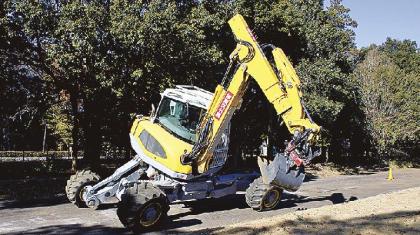
A “Spider” excavator undergoes operator training in Japan to enhance disaster response operations.
Experts highly experienced in operating Spider machines provided hands-on instruction to Nippon Foundation personnel who operate construction machinery at disaster sites, while also sharing knowledge to help determine whether the equipment is suitable for use under actual field conditions.
The Spider is a Swiss-made, multi-jointed work machine whose four independent wheels can move freely up, down, left, and right. It can operate with its body raised by up to approximately 2 meters, enabling it to traverse rocks and rubble, and can also provide operators with an elevated vantage point over disaster zones. The machine can work in rivers with water depths of up to 2 meters without the need to install temporary piers. Attachments at the front can be easily exchanged for cutting, crushing, excavation, and other tasks, allowing a single machine to perform multiple functions. While it contributes to addressing labor shortages and reducing labor costs, operation demands highly advanced driving and maneuvering skills.
In May, NILIM deployed a Spider excavator to the disaster area affected by the Noto Peninsula earthquake, in Suzu City, Ishikawa Prefecture. The machine helped complete the clearance of approximately 1.4 kilometers of road in about two weeks, a task previously expected to take more than two months, demonstrating its effectiveness even in difficult locations inaccessible to conventional construction equipment.
At present, there are 20 Spider excavators in Japan, including one owned by NILIM. In cooperation with the Japan Spider Association and The Nippon Foundation, NILIM plans to continue training operators. Given the Spider’s ability to handle a wide range of construction tasks with a single unit, broader deployment at construction sites is also anticipated. A researcher at NILIM who led the training, expressed hope that "each regional development bureau of the ministry will have one unit, and each prefecture will also maintain one." He emphasized the need to strengthen public–private collaboration to promote the disaster deployment of privately owned machines. To prevent secondary accidents involving operators, NILIM also plans to place greater emphasis on remote operation and automation technologies.