

The Ministry of Land, Infrastructure, Transport and Tourism (MLIT) of Japan and the Government of Ukraine conducted a demonstration of remote construction technology using heavy machinery in Kyiv on October 9.
From a control center in the Ukrainian capital, participants remotely operated construction equipment located at a Kobelco Construction Machinery facility in Kobe, Japan, confirming the feasibility of remote operations. The initiative aims to apply Japan’s advanced technologies to Ukraine’s postwar reconstruction.
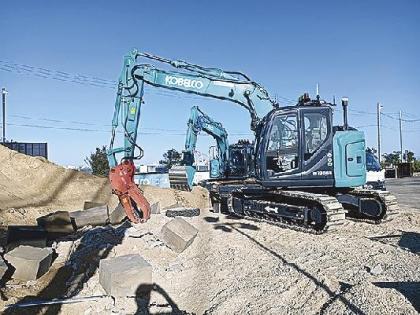
A Kobelco remote-controlled excavator used in a Japan–Ukraine demonstration linking Kobe and Kyiv, showcasing Japan’s advanced remote construction technology for postwar reconstruction.
To facilitate the introduction of such systems in debris removal, MLIT plans to urge the Ukrainian government to incorporate remote operation into its reconstruction and recovery project requirements.
Japan’s remote construction technology has a track record of more than 30 years, dating back to its first practical application during the recovery works following the eruption of Mount Unzen Fugen-dake volcano in the 1990s. It has since been refined as a technology that enables work to continue safely in hazardous environments while protecting human lives. Repeated natural disasters such as earthquakes, volcanic eruptions, and typhoons have driven further development of these technologies.
Ukraine faces a severe labor shortage, as many citizens have either fled the country or are serving on the front lines. Damaged buildings may contain asbestos, and unexploded ordnance and landmines remain scattered across affected areas. Given these dangers, conventional construction methods alone are insufficient to ensure both safety and efficiency in reconstruction efforts. To address the labor shortage, there is a growing need to enable people who cannot be physically present at construction sites - such as women with childcare responsibilities and those injured in the war—to participate in reconstruction projects.
During the demonstration, two pieces of equipment—one at Kobelco’s Technical Training Center in Chuo Ward, Kobe, roughly 8,000 kilometers from Kyiv, and another at a construction site approximately 20 kilometers from central Kyiv—were successfully operated remotely.
Ukraine’s prolonged war has caused catastrophic damage to infrastructure, including roads, bridges, and water and sewer systems. The country is also struggling with massive debris removal caused by airstrikes. Reconstruction costs are estimated to reach approximately $524 billion (about ¥79 trillion) over the next decade.
At the opening ceremony in Kyiv, an official of MLIT remarked, "With the participation of many companies through public-private collaboration, we intend to provide robust support so that Japan can make a meaningful contribution to the restoration of Ukraine’s infrastructure. We hope Japanese technology will play a significant role in Ukraine’s recovery."