

Japanese construction company Kawada Technologies Inc. is accelerating the development of full-body humanoid robots designed to work alongside humans at factories and construction sites, in anticipation of labor shortages driven by aging population.
The company has overhauled the internal systems of its already developed humanoid robot, HRP-2, and has begun operational testing at the equipment center of group company Kawada Construction. Aiming to create a versatile, general-purpose robot capable of handling task volumes that do not justify automation by dedicated machinery—such as sorting, organizing, and transporting reusable components for bridge erection—the company is working to resolve key technical challenges.
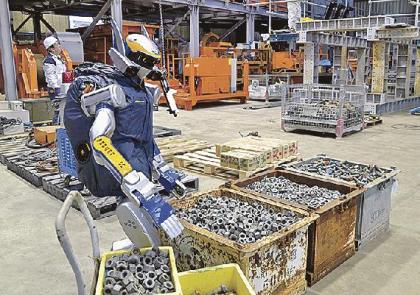
A full-body humanoid robot developed by Kawada Technologies undergoes operational testing at a factory, performing material handling tasks.
To this end, Kawada Technologies has launched joint research projects with laboratories at Hokkaido University, Osaka University, Toyohashi University of Technology, Kagawa University, and Fukui University. By combining new AI-driven approaches with conventional simulation-based design and verification methods, the partners seek to generate the technologies required for practical, deployable robots.
The new robot incorporates upgraded sensors and cameras, batteries, and communication systems, along with the introduction of a GPU (graphics processing unit) and updates to its operating system and software. By integrating and evaluating the latest advances in AI and robotics research, the company aims to develop a practical humanoid robot that can flexibly adapt to existing tools and a wide range of tasks, while being robust enough to withstand falls without sustaining damage.
Looking ahead, Kawada Technologies plans to expand verification activities from indoor factory environments to semi-outdoor facilities and ultimately to construction sites. Through repeated cycles of identifying issues, making improvements, and conducting further validation in real-world conditions, the company intends to refine performance. It will also proactively pursue necessary technological partnerships and recruit specialized personnel.