

A foreign rebar craftsman has claimed the national title in Japan for the first time.
On October 3, the National Reinforcement Contractors Association held its 6th National Rebar Skills Competition, the "TETSU-1 Grand Prix," at the Fuji Education and Training Center in Fujinomiya, Shizuoka Prefecture.
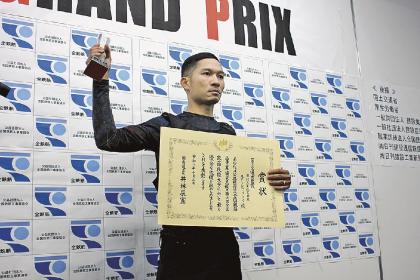
The winner displays his trophy and certificate at the sixth TETSU-1 Grand Prix. Vietnamese worker Luong Duc Quy claimed the title, becoming the first foreign worker to win Japan’s national rebar skills competition.
Luong Duc Quy, 33, representing Tamura Kogyo under the Kantetsu Kyoryokukai cooperative in the Kansai region, won first place, earning the title of Japan's "Top Rebar Worker." Born in Vietnam and now in his 11th year living in Japan, Quy holds the Specified Skilled Worker (ii) residency status and has honed his craftsmanship on domestic job sites.
Held biennially since 2015 to enhance rebar craftsmanship, this year’s tournament brought together 34 competitors who advanced through regional qualifiers across the country, including three foreign workers. Cheering squads arrived early in the morning to prepare banners bearing the contenders' names across the venue walls.
The competition tested both execution speed and dimensional precision against an assignment based on the Level 1 National Trade Skill Test for rebar assembly. Divided into morning and afternoon sessions, the event allowed a standard completion time of 1 hour and 20 minutes, with a cut-off limit of 1 hour and 40 minutes. Under the gaze of spectators, contestants assembled rebar structures with quiet focus.
Finishing times have accelerated with each tournament edition, with numerous participants completing the assignment in under an hour. The master craftsmen drew applause for their refined movements and intricate tying techniques. Following the trials, judges conducted thorough assessments of assembly quality and dimensional accuracy, scoring contestants on both speed and execution.
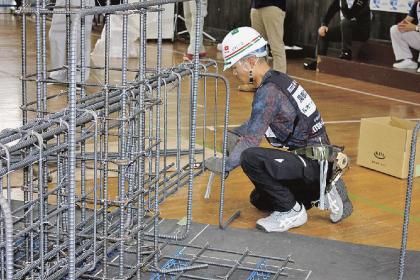
A contestant assembles a rebar structure during the sixth TETSU-1 Grand Prix in Fujinomiya, Shizuoka Prefecture, Japan, on October 3.
"Completion times continue to drop dramatically, reflecting the rigorous training behind every participant," observed a competition official. "Securing a top finish demands not only swiftness but superior craftsmanship and precision. The winner must excel on both fronts."
At the closing ceremony, Association Chairman Iwata delivered concluding remarks: "Watching everyone compete made me deeply appreciate the expertise developed in daily field operations and the tireless dedication invested ahead of this contest. This year saw three foreign workers holding the Specified Skilled Worker status participate. Looking forward, our industry must look beyond nationality, learning from and elevating one another as fellow craftspeople. This gathering should be more than a contest for rankings—it serves as a venue for peers nationwide to convene and grow."
Quy entered the competition determined to secure the title. "I was nervous at the beginning, but soon found full concentration," he said. "I finished almost exactly in line with my practice timing, which gave me confidence that I could win."
His employer, Osaka-based Tamura Kogyo is known for regularly sending Kansai-region representatives to the tournament. This year, the firm fielded two contenders: Quy and colleague Kohei Minami. Supported by the company, both took two weeks off from regular job duties ahead of the event to undergo intensive training.
The preparation resulted in a streamlined workflow free of superfluous motion. Assigned to the afternoon group, Quy completed his assembly first, recording an overwhelming time of 46 minutes.
Quy relocated to Japan on his own at the age of 22 as a technical intern trainee, joining Tamura Kogyo, where his brother—four years his senior—was already employed. Reflecting on his early days in Japan, he recalled with a smile: "There were challenges at first, but everything is fine now."
After concluding his five-year Technical Intern Training period, he shifted to Specified Skilled Worker (i), and three years ago secured the Specified Skilled Worker (ii) status, which permits family accompaniment. Upon acquiring the status, he brought his wife and daughter to Japan. He currently lives with his family of four, including his third-grade daughter and an almost two-year-old son born in Japan.
His current objective is to become a site foreman. "I want to keep working in Japan long-term," Quy stated. "I am deeply grateful to everyone at my company. Wherever they direct me, I want to take on new challenges." His proactive drive signals how skilled international talent is set to play a pivotal role across Japan's construction sites.