


The event drew large crowds throughout its half-year run, with the iconic "Grand Ring" and pavilions from around the world capturing widespread attention.
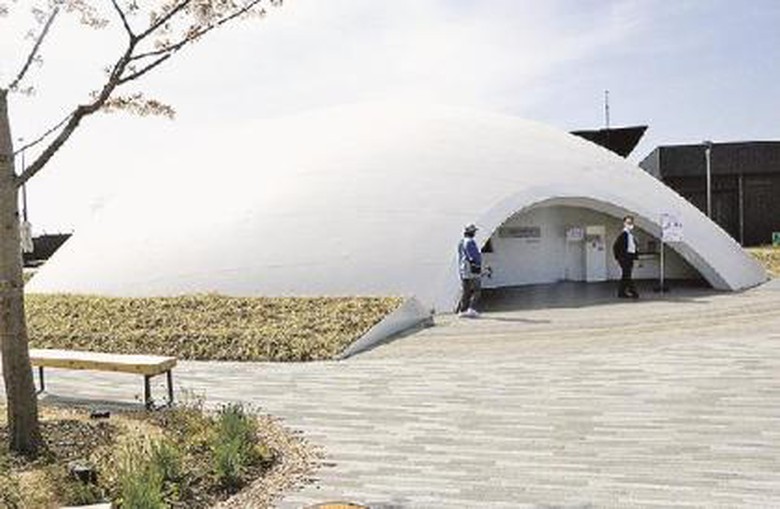
The “Sustaina Dome,” built by Kajima Corporation, absorbs and fixes CO₂ while offering environmental education programs for students at Expo 2025 Osaka–Kansai.
At Expo 2025 Osaka–Kansai, Japan’s construction companies played a major role not only in demonstrating new technologies during the development of the site but also in presenting unique initiatives through their pavilion exhibits. From the construction stage, participating firms pursued decarbonization and resource circulation, experimenting with next-generation technologies, recycled materials, and circular energy systems. The outcomes achieved over the six-month period have left a "construction legacy," embodying the industry’s vision for a sustainable future society.
General contractors, including Obayashi Corporation, introduced innovative construction methods designed to enhance productivity and promote material reuse. The Expo’s symbolic Grand Roof Ring, which incorporated approximately 27,000 cubic meters of timber, became a landmark structure symbolizing a decarbonized society.
Takenaka Corporation utilized next-generation biodiesel fuel in its construction equipment to demonstrate carbon dioxide (CO₂) emission reductions during the construction phase.
Its exhibition highlighted the fusion of Japan’s traditional timber architecture and modern technological innovation.
Kajima Corporation built the environmentally friendly "Sustaina Dome," designed to absorb and fix CO₂, offering educational programs for elementary and junior high school students to learn about environmental technologies. The Japan Pavilion, constructed by Shimizu Corporation, was built entirely of cross-laminated timber (CLT) and demonstrated renewable technologies such as the hydrogen energy system and autonomous mobility robots, presenting a comprehensive vision of sustainable energy and smart mobility.
Taisei Corporation collaborated with Central Japan Railway Company to exhibit recycled aluminum materials derived from decommissioned Shinkansen train cars, illustrating practical examples of a circular economy.
At the Sumitomo Pavilion, built by Sumitomo Mitsui Construction, walkways featured "Sustamable," an artificial stone made from cement-free, environmentally friendly concrete.
The Netherlands Pavilion, constructed by Asanuma Corporation, was designed to be relocated to Awaji Island after the Expo, setting a precedent for circular architecture.
Konoike Construction reused plastic waste generated on-site to create podiums, while Eight-Japan Engineering Consultants installed waste bins made from timber sourced in Tokushima Prefecture, promoting the use of local materials. Maeda Road Construction showcased recycled pavement base materials capable of fixing CO₂, sharing Japan’s decarbonization efforts in the paving sector. Toa Road Corporation installed photovoltaic pavements in parking areas, demonstrating the potential for energy-generating road surfaces.
At the largest pavilion, "The Future City", Aoki Asunaro Construction and Komatsu jointly exhibited a remote demonstration of an electrically powered underwater construction robot equipped with ICT functions and automated controls, illustrating how future construction sites could enable diverse participation. The CP Concrete Consortium, led by Ando Hazama, introduced next-generation concrete capable of continuously absorbing CO₂, which was used in both pavement and benches. By October 9, the consortium’s exhibition booth had attracted more than 300,000 visitors.
Bình luận bài viết (0)
Gửi bình luận