


The decarbonization of Japan's road sector is gaining significant momentum under the revised Road Act. According to the Ministry of Land, Infrastructure, Transport and Tourism (MLIT), the Hokkaido Development Bureau, the Okinawa General Bureau, all Regional Development Bureaus, and expressway companies have finalized their respective Road Decarbonization Plans.
Among local governments, 14 prefectures and 20 municipalities have also compiled their plans. The widespread introduction of renewable energy and energy-saving equipment leveraging road spaces is expected to substantially curb carbon dioxide emissions across road-related sectors.
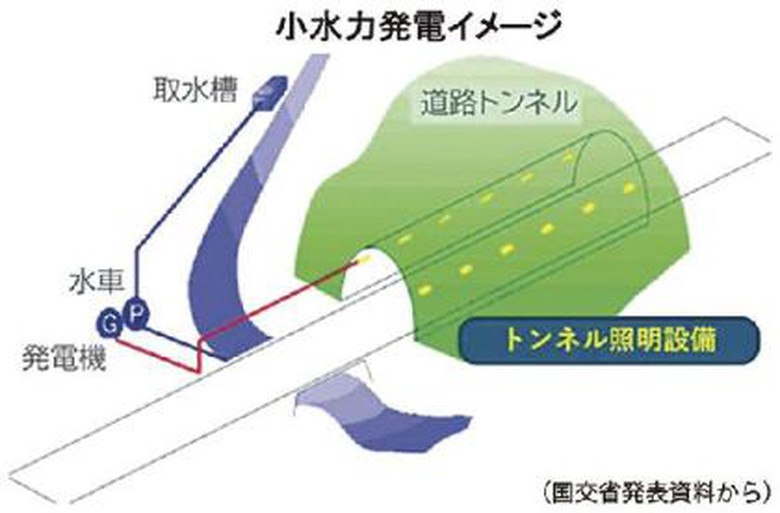
Small-scale hydropower plant on road.
The initiative comes against a backdrop of increasingly severe and frequent natural disasters driven by climate change. According to "Decarbonization Policies in the Road Sector Version 2.0," published by MLIT in October 2025, emissions from road sectors account for approximately 18% of Japan's total domestic CO2 emissions. In response, the government has accelerated decarbonization efforts across the construction, utilization, and management phases of road infrastructure. MLIT has set targets to reduce emissions by 46% by fiscal 2030 compared to fiscal 2013 levels, and by 73% by fiscal 2040.
The revised Road Act, which came into effect in April 2025, established a framework enabling road administrators to formulate decarbonization plans. The legislation relaxes road occupation permit standards for facilities that contribute to carbon reduction, thereby backing the deployment of renewable energy equipment within road spaces.
Advanced technologies are already being deployed nationwide through initiatives tailored to regional characteristics. The Chubu Regional Development Bureau has installed solar-powered streetlights that utilize repurposed, used batteries, while the Kinki Regional Development Bureau is advancing an initiative to harness wave-power generation to operate road management facilities. In northern regions, the Tohoku and Hokuriku Regional Development Bureaus have introduced snow-melting systems powered by groundwater and geothermal heat, warming pavements to reduce electricity consumption during snow clearance.
West Nippon Expressway Company plans to install lightweight, flexible film-type perovskite solar cells on the parking lot roofs of the Katsuragawa Parking Area on the Meishin Expressway. This installation is scheduled for completion by the end of the year, with feasibility studies underway to expand application to expressway soundproof walls. Furthermore, the Shikoku Regional Development Bureau is utilizing small-scale hydropower generated from water inflowing during tunnel construction to run road maintenance operations.
Bình luận bài viết (0)
Gửi bình luận