


Amid an intensifying domestic labor shortage, an increasing number of companies open their doors to overseas workers and the population of foreign construction skilled laborers continues to grow.
Today, foreign workers account for approximately 12% of all skilled construction laborers in Japan, establishing themselves as a cornerstone of the industry's workforce across a highly diverse range of nationalities. "Foreign personnel have become absolutely essential," a general contractor executive noted. "We want to be a company that workers actively choose as their place of employment."
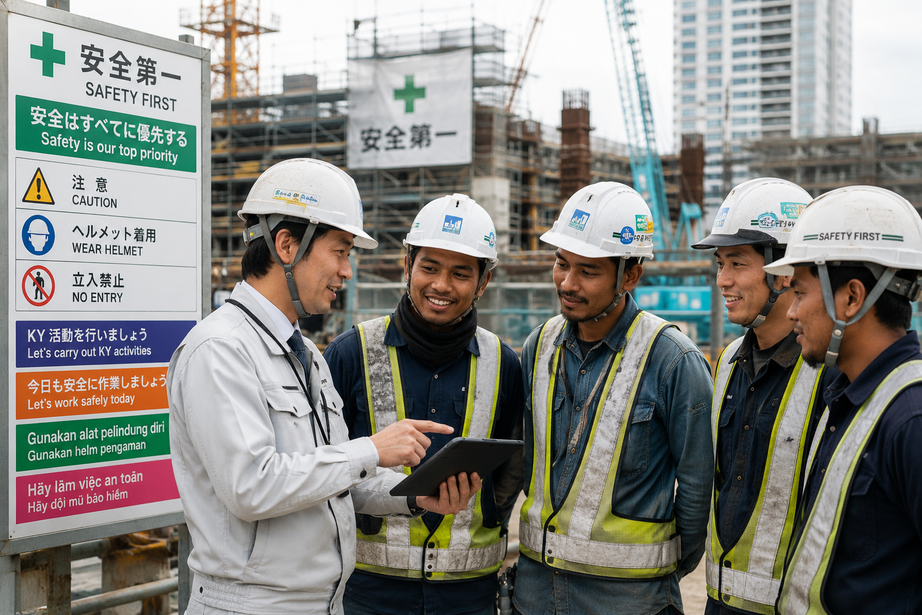
Foreign construction workers attend a safety briefing at a Japanese construction site as companies strengthen efforts to create more inclusive workplaces. (Illustrative photo)
To facilitate seamless integration, general contractors are implementing a variety of practical measures, such as installing multilingual safety signage, introducing real-time translation apps across corporate operations, and translating safety education materials into English. To ensure safety and quality control on-site, some companies have also initiated specialized, individualized safety briefings that run separately from standard daily Hazard Prediction (Kiken Yochi) activities.
However, a rising trend in occupational accidents among foreign workers remains a critical challenge. Communication gaps and language barriers occasionally impede comprehensive safety awareness, leading to on-site mishaps. General contractor executives have highlighted the underlying complexities of integration, noting that it demands substantial time and cost. They emphasize that if sufficient communication cannot be maintained within a site, it directly compromises quality and safety, adding that a larger foreign workforce inherently raises accident risks unless managed with a safety-first approach.
Furthermore, some executives point out that there is a limit to what individual companies can achieve on their own. Industry representatives urged public clients to expand the scale of public works expenditures and guarantee specific budgets to cover the costs of multilingual localization, such as digital noticeboards and translation tools. In response, Regional Development Bureaus stated they would monitor the actual situation regarding these necessary expenditures through their ongoing construction overhead cost trend surveys. Meanwhile, prefectural governments are independently deploying custom support frameworks. Kanagawa Prefecture has established a "Workplace Environment Improvement Support Incentive" to fund initiatives such as translating internal manuals and updating on-site signs into multiple languages.
Similarly, Aomori Prefecture operates a dedicated "Foreign Personnel Employment Support Desk" to provide administrative guidance on employment procedures and workplace readiness. Shimane Prefecture offers a subsidy, which covers the cost of purchasing translation devices, installing or modifying multilingual signage, and funding Japanese language education and skill acquisition programs to improve working conditions and foster better workplace communication.
As the shortage of core laborers grows increasingly acute, securing a sustainable future workforce has become a paramount objective for the Japanese construction industry. Many industry executives agree that expanding entry pathways now is vital to remaining competitive and attractive to both young domestic workers and international personnel. Cultivating an inclusive environment where a diverse workforce can thrive is increasingly viewed not just as a corporate necessity, but as a long-term prerequisite for safeguarding national infrastructure and public safety.
Bình luận bài viết (0)
Gửi bình luận