


The system combines Taisei Corporation's direct-current (DC) power supply system, Taisei Rotec's pavement-embedding construction methods, and Honda R&D's power transmission and vehicle-side reception units compatible with DC distribution.
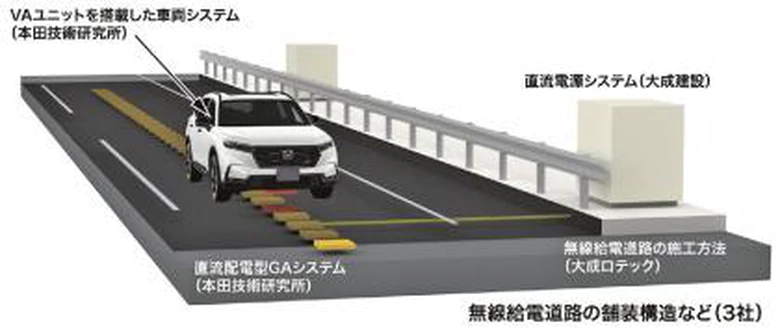
An illustration shows how road-embedded equipment wirelessly supplies power to an electric vehicle in motion.
Anticipating early commercial deployment for heavy-duty commercial logistics, the companies plan to initiate on-road demonstration trials on an active expressway in fiscal 2027 and beyond.
Development leads from the three firms held a press briefing in Tokyo on October 5 to unveil the fundamental technology behind their "magnetic coupling wireless power transfer road system," designed to deliver contactless power to moving EVs.
Engineered to wirelessly charge heavy commercial vehicles weighing up to 20 metric tons, the platform delivers up to 150 kilowatts of power, ranking it among Japan's largest dynamic wireless power transfer systems.
The team aims to establish a pavement structure engineered to endure repetitive wheel load testing exceeding 1 million passes (equivalent to 49-kilonewton standard wheel loads).
The consortium has already verified the pavement structure and DC power supply setup for heavy-vehicle dynamic charging at Taisei Group's Research Institute in Saitama Prefecture.
Spanning from late 2026 into early 2027, the partners will construct a test track approximately 40 meters long and 3.2 meters wide at the Taisei Group Next-Generation Technology Verification Center in Fukushima Prefecture.
Using real vehicles, the trials will assess long-term pavement durability and dynamic power transmission performance at maximum 150 kW output, while also formulating renewal and maintenance procedures for the wireless infrastructure and evaluating electromagnetic field (EMF) mitigation measures.
Bình luận bài viết (0)
Gửi bình luận