


Concluding the debate, the Minister affirmed that the drafting agency would fully absorb National Assembly deputies’ recommendations and work closely with the verifying body to refine the draft ahead of submission at the 10th session.
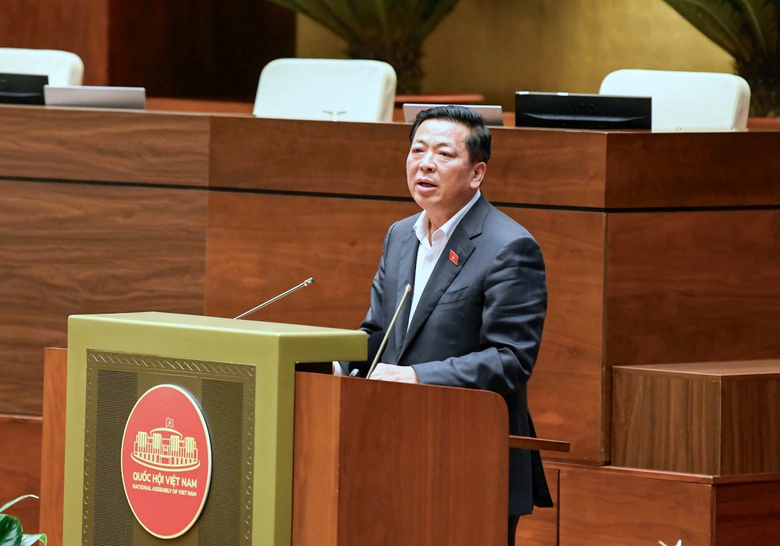
Minister Tran Hong Minh speaks at the November 28 National Assembly session, clarifying key issues in the draft amendments to the Urban and Rural Planning Law. (Photo: National Assembly Media)
According to the Minister, nearly 300 institutes and centers nationwide are engaged in planning consultancy, and major cities operate their own specialized planning and architectural institutes. With the two-tier local government model, he stressed the need for synchronized planning from provincial to communal levels to ensure consistency.
Regarding appraisal capacity, he said reorganized provincial Departments of Construction now have teams of 60–70 specialized engineers, enabling them to form appraisal councils. For large-scale or national-level planning, the Ministry supplements its expertise by hiring leading external specialists.
Clarifying approval authority for urban subdivision planning, he noted that plans located within a single commune-level unit would be approved by the commune-level People’s Committee, while those crossing administrative boundaries would fall under the provincial-level People’s Committee.
The Minister added that the draft law refines the classification of the national urban system based on strategic role, socio-economic conditions, urbanization level, and the development of technical, social and digital infrastructure, designating Hanoi and Ho Chi Minh City as special-class urban areas.
He emphasized that urban classification serves as the foundation for reorganizing the national urban network, with criteria to be soon approved by the National Assembly Standing Committee.
Bình luận bài viết (0)
Gửi bình luận