


Minister of Construction Tran Hong Minh emphasized that synchronized development of transport infrastructure is a crucial foundation for enhancing regional connectivity, expanding development space and achieving high economic growth in the coming years.
Speaking at a National Assembly plenary session on April 20, the minister underlined that infrastructure - particularly transport - plays a key role in realizing the country’s growth targets, in line with conclusions of the Party Central Committee.
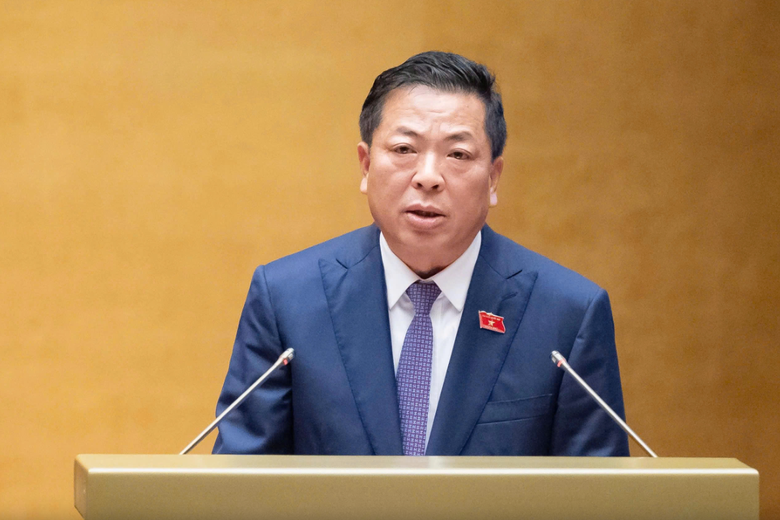
Minister Tran Hong Minh speaks at a National Assembly session on April 20, emphasizing transport infrastructure as a key driver of economic growth.
In the road sector, Vietnam aims to develop a network of 43 expressways with a total length of approximately 8,993km by 2050. Of this, about 6,539km are expected to be completed before 2030. Between 2026 and 2030, around 1,721km of expressways will be upgraded or expanded, including widening from two or limited four lanes to six lanes, with total investment estimated at VND 802.8 trillion.
For railways, the national network is planned to include 25 lines with a combined length of 6,658km, comprising seven existing lines and 18 new ones. Meanwhile, urban rail development is set to accelerate, with Hanoi planning 18 metro lines totaling 1,052km and Ho Chi Minh City 12 lines totaling 1,172km. Nationwide, the urban rail system is projected to reach about 2,224km, requiring an estimated VND 743.9 trillion in investment.
In the aviation sector, Vietnam is expected to have 31 airports by 2030, including 15 international and 16 domestic facilities, with a total capacity of around 294 million passengers per year. By 2050, the number is projected to rise to 34 airports, with a combined capacity of 533 million passengers annually.
Regarding maritime and inland waterways, the country currently operates 309 port terminals with a total quay length of about 107km. The system’s capacity has reached approximately 955 million tonnes per year, 1.3 times higher than in 2020. The government will continue promoting private sector participation in seaport investment while improving shipping routes and decentralizing inland waterway port management to local authorities.
The Minister reaffirmed that accelerating transport infrastructure development will serve as a key driver for economic growth and sustainable development in the years ahead.
Bình luận bài viết (0)
Gửi bình luận